What is the Capacity Market?
Last week marked the close of the annual Capacity Market auctions, successfully securing electricity security of supply for delivery years 2026/27 and 2029/30.
The Capacity Market is the government’s main mechanism for ensuring security of supply.
The Capacity Market procures capacity one and four years ahead of time to ensure the UK can either increase supply or reduce demand on the grid when required, primarily at peak times between 4-7pm.
It is technology-neutral, targeting capacity without valuing one technology over another. The scheme has been running for 10 years and has successfully procured over 475 GW since its inception.
The Capacity Market ensures that in a scenario where supply may be unable to meet demand, back up capacity can be utilised.
This scenario is called a System Stress Event, which would mean a Capacity Market Unit would be required to generate or turn down.
The auctions
Both auctions were liquid and procured the targeted capacity. It is a descending clock auction, with each round decreasing by £5 and only clearing once the capacity remaining in the auction meets the target.
T-1 Auction
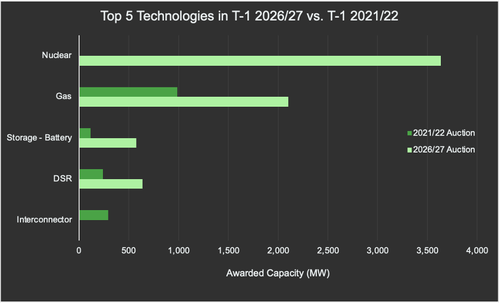
The T-1 Auction secured 7.192 GW at £5 KW/year which is the cheapest T-1 since 2020/21. The auction procured the highest amount of unproven Demand Side Response in any T-1. Demand Side Response is the reduction of demand on the system when called upon, such as a stadium turning down its lights or a house turning off its electric vehicle charger.
This increase and shift in Demand Side Response in the Capacity Market shows how the electricity system overall is shifting and providing security of supply reflects this. Agreements awarded to gas capacity have also reduced since 2018/19, where 4.34 GW was secured compared to 2.1 GW in the recent T-1.
T-4 Auction
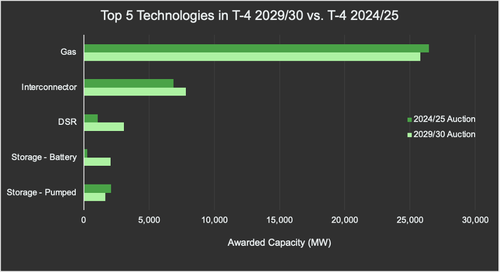
The T-4 Auction saw a 45.2% rise in Demand Side Response capacity compared to the last T-4 Auction. Most of this was unproven Demand Side Response, meaning it is capacity that has not yet proven its services and has not completed the relevant testing to demonstrate its ability to reduce demand. There was also a 14.5% rise in interconnectors compared to a 13.9% decrease in gas capacity, showing the shifting nature of types of capacity which provide security of supply.
The T-4 Auction also successfully secured 97 new build agreements with 1,250 MW of awarded capacity to such agreements, enabling new capacity to come through and provide system resilience whilst older capacity retires.
What next?
As the Settlement Body for the Capacity Market, we are gearing up for the Pre-Delivery year activities, encouraging Capacity Market agreement holders to get the data set up early and ready ahead of the 1 October (start of the Delivery Year).
Electricity Settlements Company (ESC), along with EMR Settlement (EMRS), is holding a Pre-Delivery Year event on 22 April 2026, which will be an opportunity for Capacity providers to come together, ensure readiness for October and discuss any concerns with us.
Registration for the Pre‑Delivery Year event is now open.